
Every healthcare conference booth looks the same.
Sterile. Clinical. Bright fluorescent lighting. Hard surfaces. Product screens. Branded tablecloths. The aesthetic says: we’re serious medical technology.
Everyone follows the same playbook because that’s what healthcare marketing looks like. The convention becomes invisible. No one questions it.
Until constraint forces you to.
Building CalmWave’s conference presence on a tight budget, we couldn’t compete on scale or production value. Couldn’t afford the massive booth, the video walls, the elaborate product demos.
That constraint forced a different question: what if the problem isn’t our budget—what if it’s the category’s assumptions about what a healthcare booth should be?
What if we rejected that entirely?
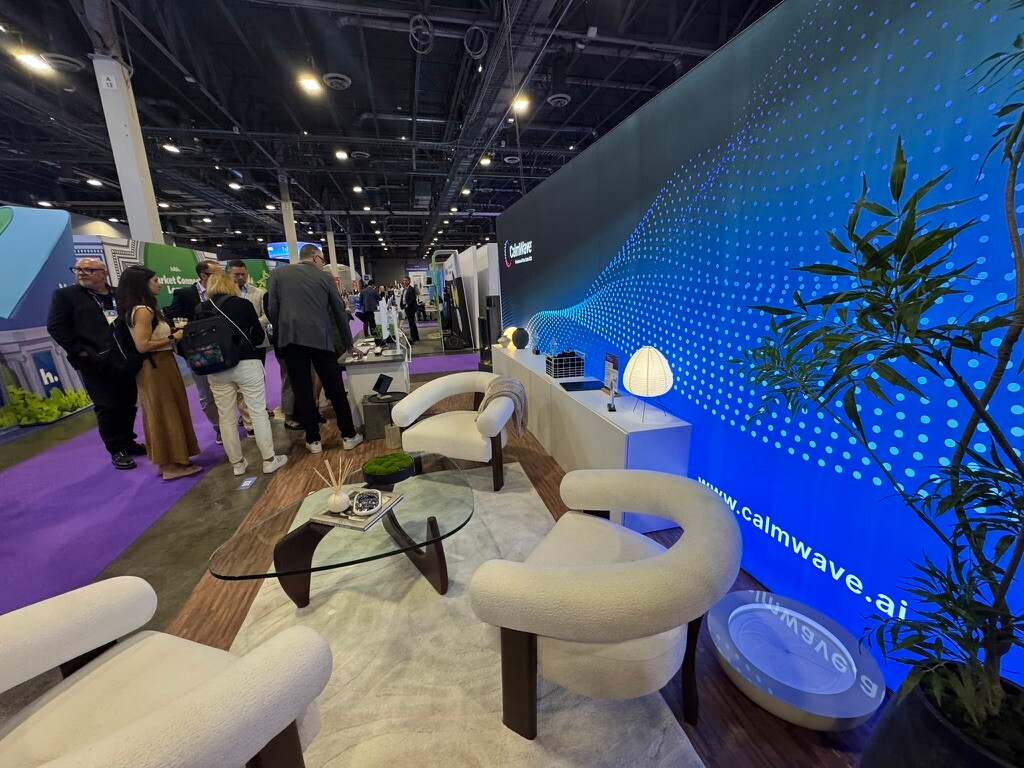
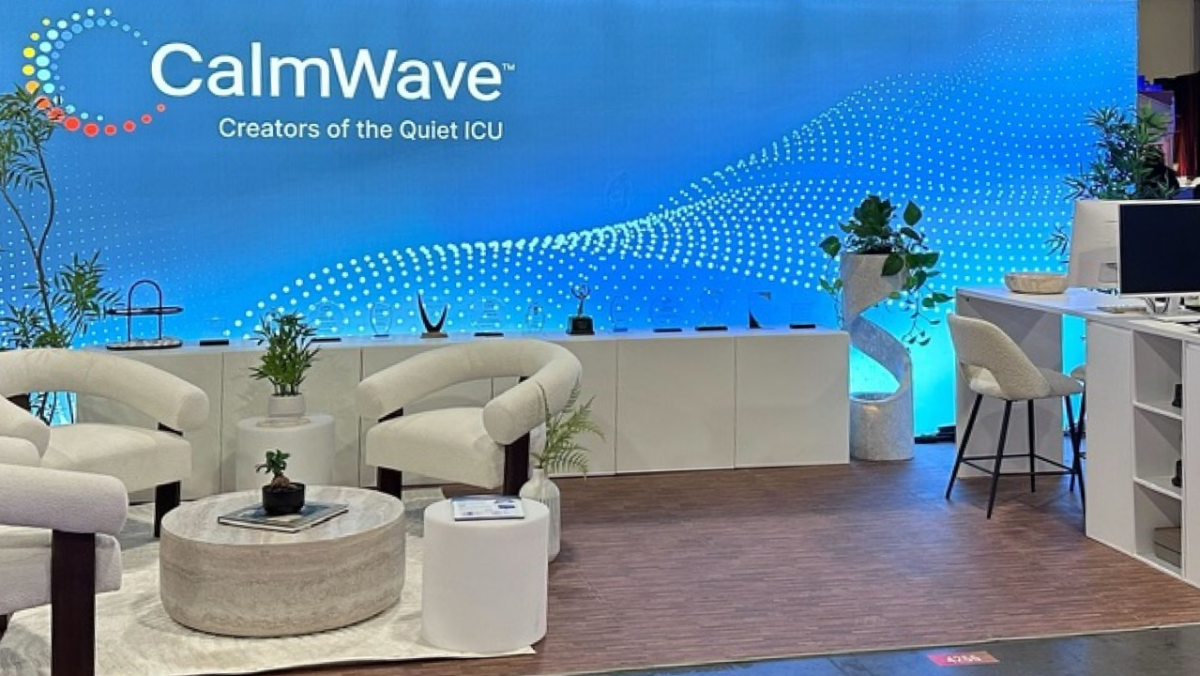
Instead of “healthcare conference booth,” we built a living room.
Residential furniture—not commercial expo pieces. Comfy armchairs you’d actually want to sit in. A fountain with live plants. A tabletop kinetic zen garden. Signature scent diffusers. Soft lighting. Warm textures. The aesthetic language of calm, not clinical precision.
We probably spent less than half what most companies invest in their booths. But the emotion came through.
The feedback: “This doesn’t feel like a healthcare booth. We actually want to stay here.” Many people—including a leader from IDEO, one of my design firm idols—told us it was their favorite booth at the conference.
Not “nice booth”—but “this feels different from everything else.”
Heavy constraints don’t just force creative problem-solving. They force you to question which rules are actually just conventions.
When you have unlimited budget, you can play the category game better than competitors. Bigger booth, better screens, more impressive production. You’re still operating within the same assumptions everyone else accepts.
When budget is constrained, those assumptions become visible. You can’t just do the standard thing smaller. You have to ask: why does everyone do it this way? What are we actually trying to accomplish? What would serve that goal better?
For healthcare conferences, the convention is: look clinical, look serious, demonstrate credibility through medical aesthetic language.
The constraint forced us to question: does that actually create the experience we want? Or is everyone just copying what successful companies did, assuming those choices were strategic when they might have just been defaults?

This same thinking shaped how we approached making alarm fatigue tangible and memorable.
We needed to solve four problems simultaneously:
- Stand out in a stagnant industry where everyone does the same thing
- Make alarm fatigue—an abstract operational problem—visceral and memorable
- Educate on CalmWave’s capabilities in a way that works anywhere, without needing a sales conversation
- Create something people would actually want to engage with and share
Standard approach: dashboards on screens, feature callouts, ROI statistics. Everyone does that.
We designed a card game instead.
Players manage ICU chaos—responding to escalating scenarios, juggling competing alerts, trying to survive the shift. The game mechanics mirror real alarm fatigue: decision overload, alert cascades, burnout. Then Calm cards—named after CalmWave’s actual features like Threshold Manager™, Incident Patterns™, Alarm Manager—let players resolve the chaos.
People won’t be learning our pitch deck. They’ll experience the problem our product solves, and learn our differentiators by playing them.
The game makes infrastructure software tangible in a way dashboards alone can’t. Hospital operations chaos becomes a 15-minute experience that sticks. And it rejects the category assumption that enterprise software education has to be transactional—what if it could be collaborative, memorable, something people would actually want to engage with and share?
The mechanism: constraints reveal which category rules are strategic and which are just mimicry.
Unlimited budget lets you execute better within existing conventions. You can afford the best version of what everyone else is doing.
Constraint forces you to evaluate: is this convention serving the goal, or is it just what successful companies did before us?
Healthcare booths are clinical because… that’s what healthcare booths are. Not because clinical aesthetic creates better conversations or makes software more memorable. Just because that’s the category default.
When you can’t afford to play that game, you’re forced to question it. And questioning conventions is where creative differentiation begins.
This applies beyond physical design:
When building messaging architecture for technical products with limited resources, you can’t paper over complexity with content volume. That constraint forces clarity. But it also forces you to question: why does enterprise software messaging look the way it does? Is that serving buyers, or is it just category convention?
The same thinking shaped how CalmWave’s team shows up at conferences. Healthcare software companies default to: polished, clinical, transactional. We questioned that. What if warmth and empathy aren’t unprofessional—they’re what clinicians actually need?
After HLTH, a nurse posted about walking the expo floor. She described the difference immediately: “Their staff was warm. Friendly. Grounded. They explained how their software actually helps frontline staff… The difference in their energy and values was striking.”
She felt it before anyone explained it. That’s what happens when you reject category conventions about how healthcare tech companies should behave.
The shift happens when you stop asking “how do we work within these constraints?” and start asking “which constraints are real and which are just inherited category assumptions?”
Budget constraints are real. Production timelines are real.
But “healthcare booths must look clinical” isn’t a constraint—it’s a convention. “Software education must be transactional” isn’t a constraint—it’s a default. “Enterprise messaging must be formal” isn’t a constraint—it’s mimicry.
Heavy constraints force you to see the difference.
Most companies facing budget limitations try to approximate what well-funded competitors do, just cheaper. Smaller booth. Lower production value. Fewer assets.
That’s still playing the same game, just with worse resources.
The companies that produce distinctive work use constraint to question the game itself. What if the category’s assumptions aren’t strategic requirements—they’re just inherited defaults no one’s bothered to challenge?
If you’re facing constraints—limited budget, tight timeline, small team—the question isn’t “how do we make the standard approach work with less?”
It’s “which ‘rules’ are we following just because that’s what everyone does?”
The convention becomes invisible when you have resources to execute it well. Constraint makes it visible. And visible conventions can be questioned.
That questioning is where creative leverage begins.